
Have you ever heard of a Bullion Bank, often called a Gold Bank? Unlike conventional banks, which handle paper or digital cash day to day, this kind of bank treats precious metals such as gold, silver, platinum, and palladium as its main "currency."
The good news is that this banking system now exists not only abroad but is also starting to be implemented in Indonesia. Let's go through what a Bullion Bank is, its main functions, and its development at home!
What Is a Bullion Bank?

Simply put, a Bullion Bank is an investment bank, or a special department within a giant commercial bank, that serves as a key intermediary in the global precious metals market.
Instead of handling ordinary cash transactions, bullion banks transact in physical precious metals and their derivative instruments. These transactions are usually conducted at a very large, wholesale scale. Bullion banks ensure that the global gold and silver trading ecosystem runs smoothly, safely, and very efficiently.
The 5 Main Functions of a Bullion Bank

In its operations, a gold bank has several crucial functions:
- Trading: Acting as a market maker by buying and selling precious metals in the global market to keep liquidity healthy.
- Vaulting: Providing high-security vaults for storing large-scale physical gold or silver.
- Clearing: Facilitating the transfer of precious metal ownership between institutions without having to physically move gold from one vault to another.
- Lending: Lending physical gold. For example, lending raw gold to jewelry makers to be processed, with the loan later repaid in gold (or money) plus interest.
- Hedging: Helping mining companies or industries lock in future gold prices to avoid losses from sharp price swings.
Who Are Their Main Clients?
Bullion banks generally do not serve individuals or the general (retail) public. Their core clients are large-scale entities, including:
- Central banks: Holding a country's gold foreign-exchange reserves.
- Mining companies: Needing operating-capital financing or a sales channel for mining output.
- Industry and jewelry makers: Needing a supply of raw materials.
- Institutional investors: Such as managers of pension funds, mutual funds, or gold Exchange-Traded Funds (ETFs).
Globally, these banks operate under the strict standards of the London Bullion Market Association (LBMA), the world's largest Over-The-Counter (OTC) gold trading hub. Some of the banking giants offering this service include JPMorgan Chase, HSBC, Standard Chartered, UBS, and Scotiabank.
The Arrival of Bullion Bank in Indonesia
As one of the countries with the world's largest gold mining reserves, it would be a shame for Indonesia not to make the most of this asset. For this reason, on February 26, 2025, the government officially launched bullion business activities in Indonesia.
A Clear and Strong Legal Basis
Gold banking services in Indonesia do not operate haphazardly. They are regulated and closely supervised through an official OJK rule, namely Financial Services Authority Regulation (POJK) Number 17 of 2024 on the Conduct of Bullion Business Activities. This regulation is the legal foundation allowing Financial Services Institutions (LJK) to perform gold bank functions in Indonesia.
Who Are the Official Operators?

Currently, licenses as pioneer bullion bank operators are held by two major financial institutions in Indonesia:
- PT Pegadaian: Manages dozens of tons of gold and dominates the services through gold savings products, bullion trading, and gold deposits.
- Bank Syariah Indonesia (BSI): One of the first banks to facilitate managed-gold services on a large scale to the wider public, including installment, pawn, and gold savings programs.
The 4 Main Services of Gold Banks in Indonesia
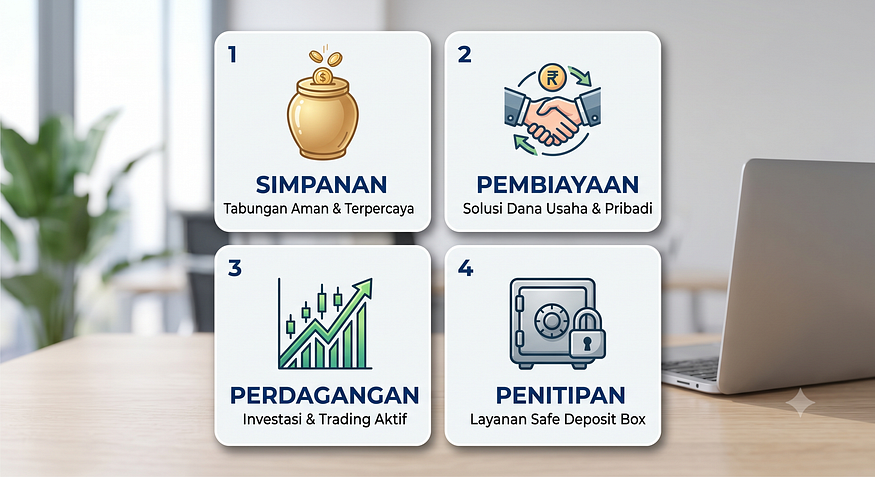
Under OJK rules, the financial services institutions that act as gold banks in Indonesia focus on four pillars of service:
- Gold deposits: Customers (individuals or corporations) deposit gold for safekeeping, which the institution can then put to productive use. Similar to saving cash.
- Gold financing: Providing credit in the form of physical gold to parties who need it (such as the domestic jewelry industry).
- Gold trading (Bullion Trading): Bridging buy-and-sell transactions of globally standard gold bars (minimum purity 99.9%).
- Gold custody (Vaulting/SDB): A service for depositing physical gold with high security protection, in which the institution has no right to put the deposited gold to use.
Why Are Gold Banks Important for Our Economy?
The creation of gold banks has strategic targets for Indonesia's economy:
- Putting "idle" gold to use: Many Indonesians keep gold passively at home. This system entices that gold into the formal financial system, where it becomes a productive asset.
- Supporting industrial downstreaming: Local jewelry makers can borrow raw materials from within the country without having to depend continually on gold imports.
- National economic stability: Strengthening foreign-exchange reserves and the resilience of the national financial system amid global economic uncertainty.
Conclusion
The Bullion Bank is not just a passing financial market trend. In Indonesia in particular, this gold bank ecosystem is a bold and strategic step toward integrating the country's real natural resource wealth into the capital market, in order to create much stronger economic stability.