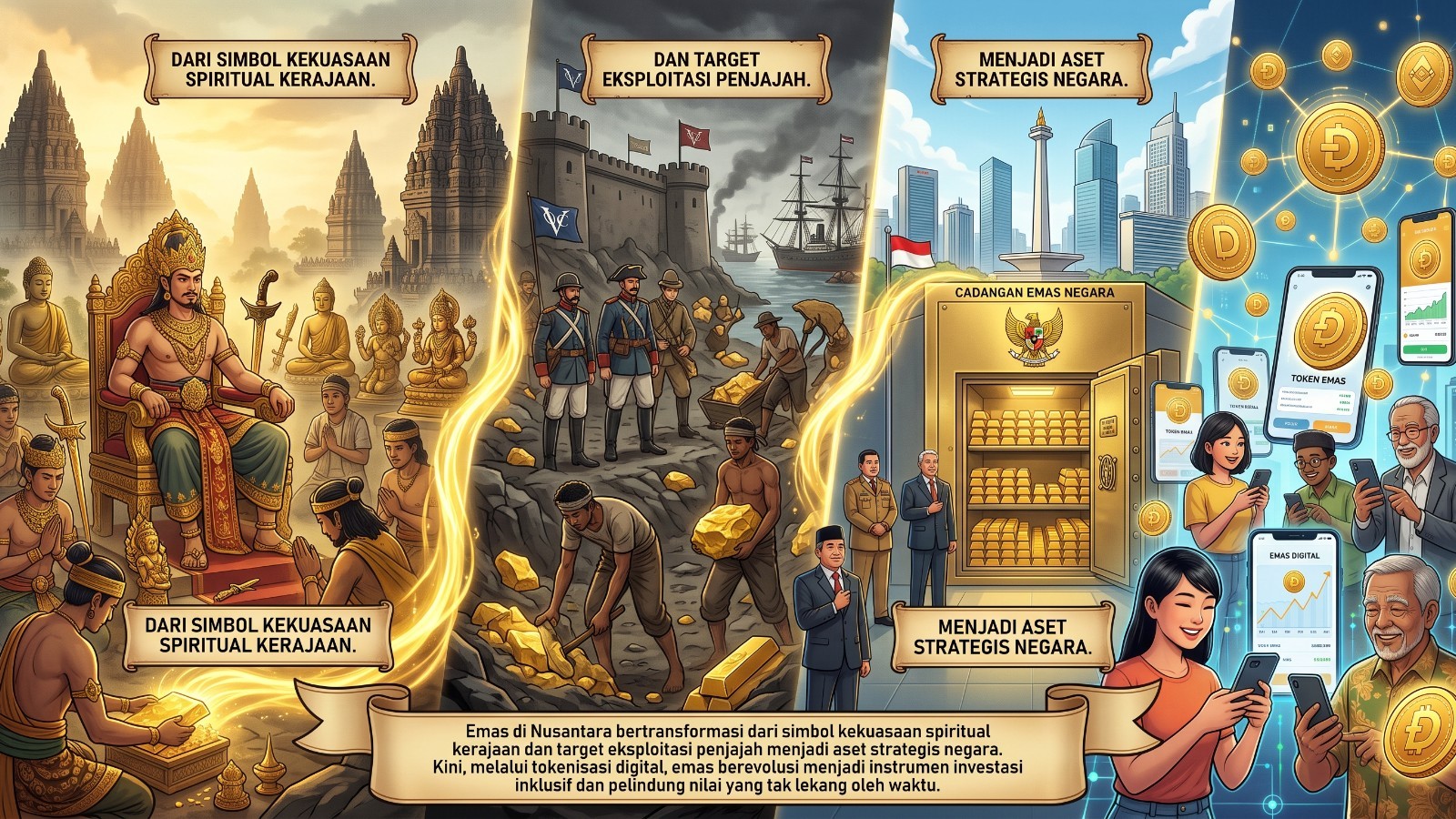
Look around you. Whether it is a ring on your finger or a digital gold balance in a finance app, chances are you own gold in one form or another.
But gold is more than an investment asset or a piece of jewelry. Behind its shine lies a long history that has shaped human civilization, including in the Nusantara (the Indonesian archipelago).
Thousands of years ago, gold was even one of the reasons European nations crossed the oceans and eventually colonized this region. In other words, the gold that feels so personal today was once a trigger for a global struggle for power.
The Age of Kingdoms: Gold as Divine Legitimacy
From the fourth century CE, in the era of kingdoms such as Kutai, Sriwijaya, and Majapahit, gold served a very different function from the one it has today.
Gold was not a primary medium of exchange. It was a symbol of supreme power, a spiritual representation, and a marker of absolute social status.
Because gold does not rust or fade, it became a symbol of eternity. This is what linked it to the rule of kings, who were regarded as sacred and unshakable.
Put simply, wearing gold in those days was like receiving direct validation from a higher power.
Geopolitical Strategy: Gold as an Instrument of Power
Gold also served as a political tool. A kingdom that displayed its gold wealth in crowns, ornaments, and grand palaces was in fact sending a message that it was strong and not easily conquered.
This was an early form of conflict deterrence through a visual show of strength. Here, however, history took an ironic turn. The glitter of gold, meant to demonstrate power, instead attracted the attention of foreign powers from outside the archipelago.
Colonialism: Gold Becomes a Commodity of Exploitation
When Europeans first came to the archipelago, they were drawn initially to spices. But after discovering abundant gold reserves, their focus shifted dramatically.
Gold underwent a major transformation: from a spiritual symbol into an economic commodity. In the nineteenth century, the Dutch colonial government began building industrial-scale mines, reshaping local social structures and forcing residents into mine labor.
The result was large-scale extraction in regions such as Sumatra, Kalimantan, and Sulawesi. Ironically, the local people who owned the land became laborers on their own land.
Meanwhile, the wealth from gold flowed to Europe, leaving poverty and environmental damage in the archipelago. The gold that was once a symbol of glory became an economic burden for the people.
Independence: Gold Becomes the Nation’s Capital
The year 1945 was an important turning point. Indonesia gained independence, but the reality was not so simple. Despite having large gold reserves, Indonesia faced limits in capital, technology, and skilled personnel.
It was like possessing a treasure without the means to reach it. To address this challenge, the government established Aneka Tambang, or Antam, in 1968.
At this point, gold changed its function once again, from a colonial commodity to a foundation for national development. Even so, these limitations meant Indonesia still needed help from outside parties.
Grasberg and Gold as a Strategic Asset
The arrival of Freeport-McMoRan in Indonesia marked a new era in gold management. The Grasberg mine in Papua became one of the largest gold mines in the world, operating with advanced technology on an extraordinary scale.
Its impact, however, was also significant, ranging from environmental concerns and social conflict to debates over ownership. At this stage, gold was no longer merely an economic commodity but a strategic asset and a geopolitical tool.
2018: Sovereignty and Responsibility
In 2018, Indonesia, through INALUM, succeeded in acquiring a 51 percent stake in Freeport Indonesia. The move was regarded as a major victory.
But ownership also means responsibility. Indonesia must now ensure sustainable mine management, protect the environment, and improve community welfare. If it is not managed well, the patterns of exploitation from the past could be repeated.
The Digital Era: Gold Becomes an Accessible Asset
In the modern era, gold has evolved once again. People can now own gold without having to store it physically. Through digital gold savings, anyone can start investing with small amounts. This has opened wider access to gold as a hedging asset.
Blockchain: The Most Revolutionary Evolution
The biggest innovation comes from integrating gold with blockchain technology. The concept is that physical gold is stored securely and then represented as a digital token.
Each token reflects real ownership of gold. This is known as real-world asset (RWA) tokenization. Its advantages are that it is transparent, secure, and can be traded globally and quickly.
Why Gold Remains Relevant
From the age of kingdoms to the digital era, one thing has stayed the same: people have always trusted the value of gold. What has changed is not gold itself, but the way people give it meaning.
From a symbol of power, to an economic tool, and now to a digital asset, gold remains a store of value amid economic uncertainty.
Gold Is Living History
Every gram of gold holds a long story about human civilization: from the glory of past kingdoms, through colonialism and the struggle for independence, to modern technological innovation.
Gold is more than an investment. It is a witness to history. And understanding its history helps us make wiser financial decisions in the future.