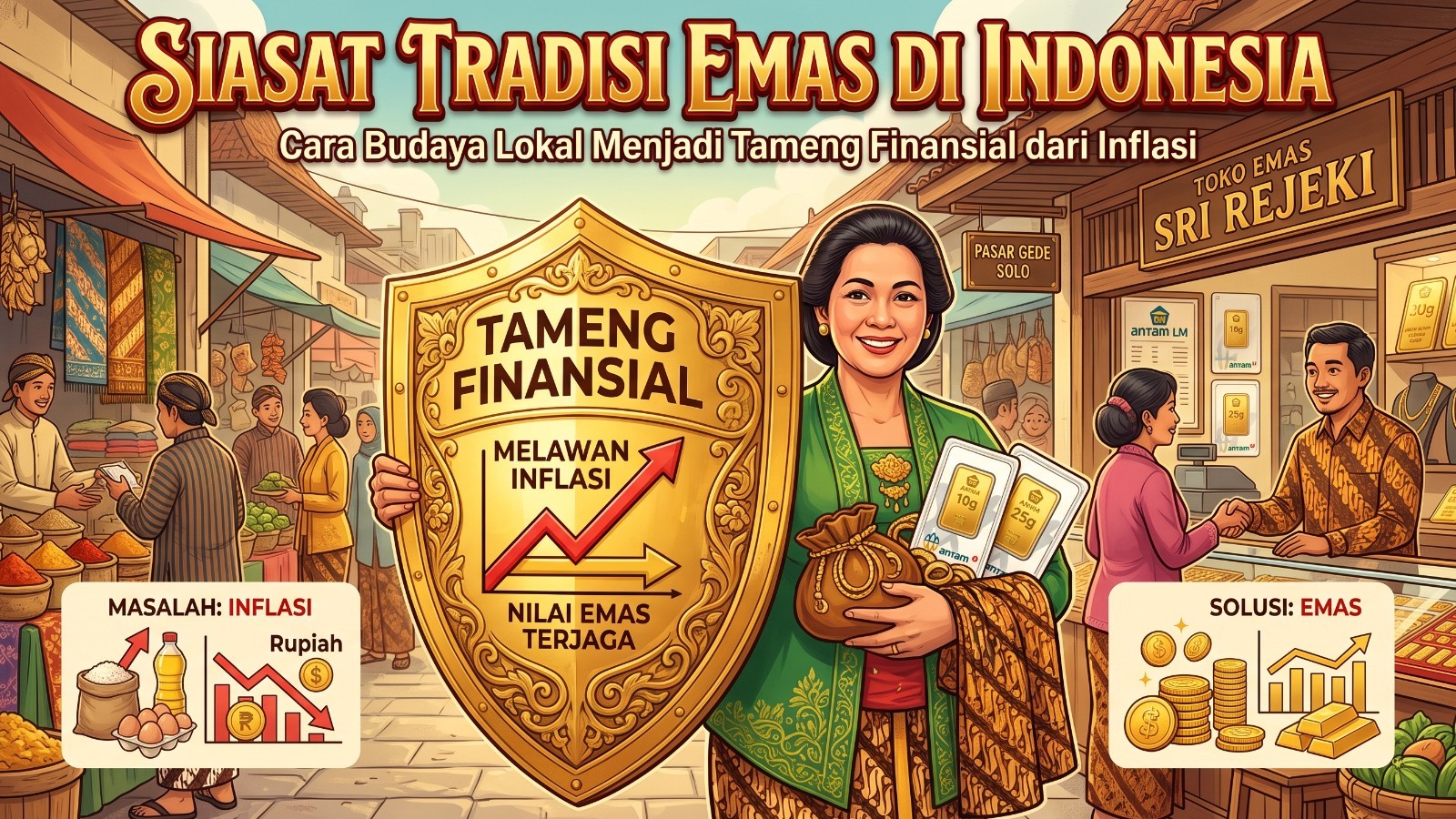
When the holiday season or a major celebration arrives, most people focus on spending: buying new clothes, preparing family feasts, and planning trips.
In Indonesia, however, an interesting phenomenon occurs. Even as consumption rises, demand for gold rises with it.
By the logic of conventional investing, buying an asset when demand is high is often considered less than ideal. Prices tend to sit at a premium, and the risk of a correction is real.
Yet the reality in Indonesia tells a different story. The habit of buying gold ahead of major holidays turns out to be more than emotional spending. It is part of a financial strategy shaped by cultural tradition.
Why Gold Is So Close to Indonesian Culture
In many Western countries, gold is known mainly as an investment instrument or a hedge during economic uncertainty.
In Indonesia, however, gold plays a far broader role. It is not just a financial asset, but also part of many important life moments, including:
- Religious holiday celebrations
- Family traditions
- Weddings
- The birth of a child
- Gifts passed across generations
As a result, demand for gold in Indonesia often follows the cultural calendar rather than global market movements alone.
The Surge in Gold Purchases During the Holidays and Holy Days
One of the most visible moments is the rise in gold purchases ahead of Eid al-Fitr.
In the lead-up to the holiday, gold shops in many cities are packed with buyers. People buy gold jewelry to wear when gathering with family.
This shows that gold serves a dual function in people’s lives.
First, gold is a symbol of celebration and family pride. Wearing gold jewelry on the holiday is often seen as a sign of success after a year of hard work.
Second, gold retains its value as an asset. After the celebration is over, its value does not disappear the way it does with other consumer goods.
This is what sets gold apart from other holiday spending.
The Concept of the “Emotional Dividend” from Gold
One interesting concept behind buying gold for the holidays is what could be called an emotional dividend.
When someone buys gold for a celebration, they gain two benefits at once.
The first is the emotional satisfaction of celebrating an important moment with family. The second is owning an asset that keeps its value over the long term.
Unlike spending on gadgets or vacations, whose value drops as soon as they are used, gold can be kept and may even appreciate.
In other words, buying gold combines emotional satisfaction with financial benefit.
Turning the THR into Savings
Another interesting phenomenon occurs after Eid al-Fitr, with the use of the THR (Tunjangan Hari Raya, the holiday bonus).
Psychologically, people often treat extra money such as bonuses or the THR differently from their monthly salary. It is often seen as extra money for enjoyment.
As a result, quite a few people spend their THR on impulse purchases.
Some Indonesians, however, take a different approach: they convert what is left of their THR into gold.
This is actually a very effective saving strategy. Once money has been turned into gold, cashing it out again takes extra effort.
This small barrier helps reduce the temptation to spend impulsively. Indirectly, gold works as a form of forced savings that supports financial discipline.
Gold Traditions During Chinese New Year
Besides Eid, spikes in gold purchases also often occur ahead of Chinese New Year. In Chinese culture, gold is a symbol of prosperity, good fortune, and hope for the future.
For this reason, gold is often given as a gift to family members, especially children. Unlike cash, which is easily spent, gold has the potential to become a long-term asset.
For example, a gold coin given to a child at Chinese New Year can be kept for many years. By the time the child is grown, its value has likely increased and can be put toward education or investment. In this way, the tradition indirectly becomes a form of intergenerational wealth transfer.
Gold as a Wedding Dowry
Gold also plays an important role in Indonesian wedding traditions. Many couples choose gold as the mahar (dowry). This decision is based not only on symbolic value but also on financial considerations.
If the dowry is given in cash, its value will steadily be eroded by inflation. Gold, by contrast, tends to preserve its purchasing power over the long term. For this reason, a gold dowry is often regarded as a financial safety net for newlyweds.
In an emergency, such as job loss or a sudden medical need, gold can be sold relatively quickly to raise cash.
Micro-Investing for a Child’s Future
Gold traditions also often appear at the birth of a child. Many families buy a small amount of gold, around 1 to 5 grams, for a newborn. Although it looks simple, this habit is in fact a form of long-term micro-investing.
Rather than immediately saving a large sum for the child’s future, parents can buy gold gradually each year. For example, they could buy 1 gram of gold on each of the child’s birthdays.
If this habit is kept up for 15 to 20 years, the accumulated gold can become a substantial fund for education or the child’s future needs.
Gold as a Safe Haven in Economic Crises
Beyond its place in many cultural traditions, gold is also known as a safe-haven asset. During periods of high inflation, global economic uncertainty, or currency weakness, many investors move part of their assets into gold.
This is why gold is often used to protect the value of wealth over the long term.
The Digitalization of Gold Investment
As technology develops, the way people invest in gold is changing too. Where buying gold once meant going to a gold shop in person, gold is now also available in digital form.
One of the innovations to emerge is a gold token such as GOIDR. This token has a secured value like physical gold and is available on several digital asset trading platforms, such as:
- Indodax
- GudangKripto
With this technology, people can invest in gold in a more practical way, without having to store physical gold themselves. However, it is important to remember that investing in digital assets still carries risk. For that reason, portfolio diversification remains an important strategy in managing investments.
Traditions That Quietly Build Wealth
Viewed as a whole, the tradition of buying gold in Indonesia has some very interesting financial effects. Seemingly simple habits, such as buying gold at Eid, giving gold at Chinese New Year, or setting gold aside for a child, help people to:
- save consistently
- protect the value of their wealth from inflation
- build assets across generations
In other words, these cultural traditions have become an effective financial strategy that does not feel like complicated investing.